 ES
ES NL
NL EN
EN FR
FR PTPT
PTPT
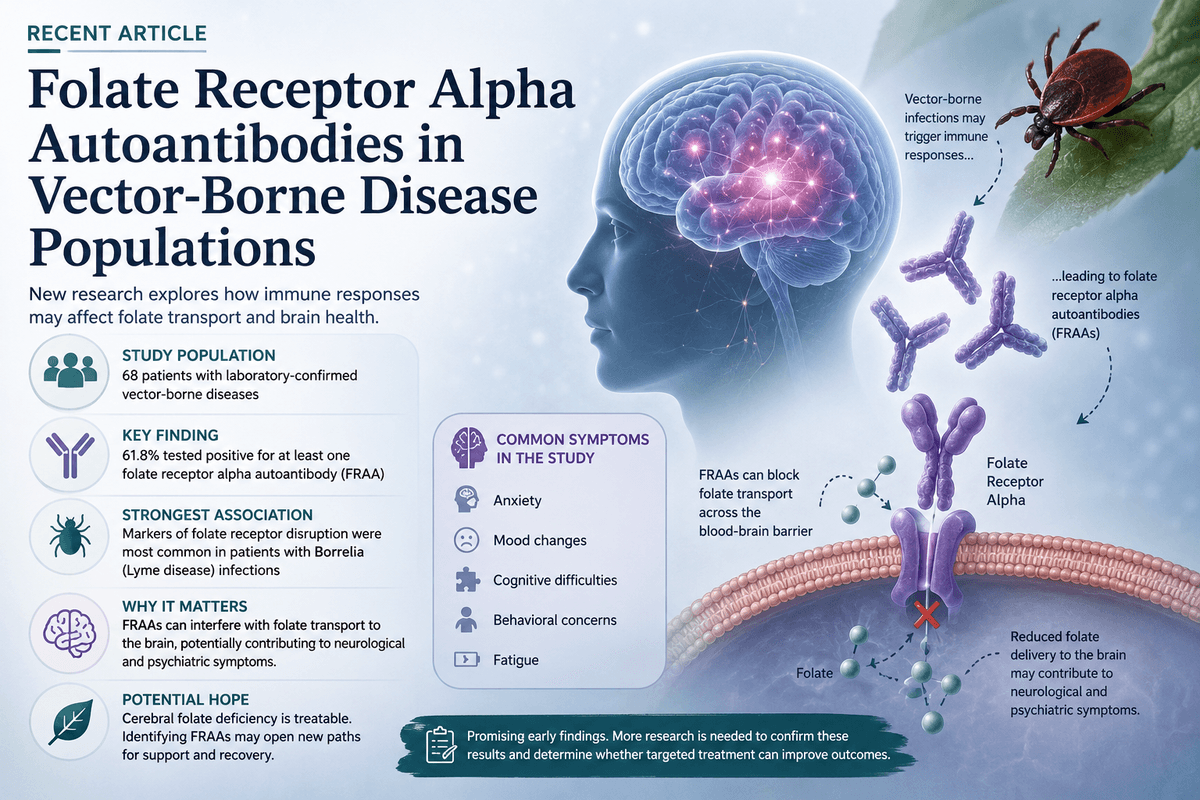
A recent article published in the peer-reviewed scientific journal Diseases by Dr. Richard Frye and colleagues explores the prevalence of folate receptor alpha autoantibodies (FRAAs) in patients with vector-borne diseases. The study, "Folate Receptor Alpha Autoantibodies in Vector-Borne Disease Populations," investigates a potential connection between vector-borne infections and disruptions in the body's ability to transport folate to the brain.
Folate receptor alpha autoantibodies (FRAAs) are immune proteins that can interfere with the transport of folate into the brain and may contribute to a condition known as cerebral folate deficiency, which has been associated with a range of neurological and psychiatric symptoms.
The researchers examined 68 patients with laboratory-confirmed vector-borne diseases, including infections caused by Borrelia (Lyme disease), Bartonella, and Babesia. Their findings revealed that nearly 62% of participants tested positive for at least one type of FRAA, a rate considerably higher than that reported in the general population.
The study also found that markers indicating folate receptor disruption were most commonly observed in patients with Borrelia infections. In particular, the researchers identified a strong association between soluble folate receptor (sFR) and Borrelia infection. Because sFR may reflect disruption of normal folate receptor function, this finding raises the possibility that Lyme disease-related bacteria could contribute to folate transport abnormalities through immune-mediated mechanisms.
Neurological and psychiatric symptoms such as anxiety, mood changes, cognitive difficulties, and behavioral concerns were common among participants.
These findings contribute to a growing body of research examining how infections, inflammation, and immune dysregulation may influence neurological health. While additional studies are needed to better understand the clinical significance of FRAAs and sFR in vector-borne diseases, this research provides an intriguing new perspective on the complex interactions between infection, immunity, and neurological symptoms, and highlights a promising area for future investigation.